
If you’ve followed Nomad Girl for a while, you’ll know I’ve written before about Thailand’s tangle of visa options for digital nomads — what existed, what was coming, and what to actually expect. A lot has changed since then. The DTV finally arrived. The old Elite Visa became Thailand Privilege. The LTR matured. And I find myself back in the thick of it, except this time it’s personal.
I’m in the middle of setting up a business tied to Thailand’s property industry, and that has forced me to look at these visas through a completely different lens. Not “where can I live cheaply and work on my laptop”, but “which of these actually lets me build and own a company here.” It turns out those are two very different questions, and most of the popular nomad visas answer only the first one.
So here’s where I’ve landed, why, and the honest bumps along the way.
First, the visa most nomads reach for — and why it wasn’t enough for me
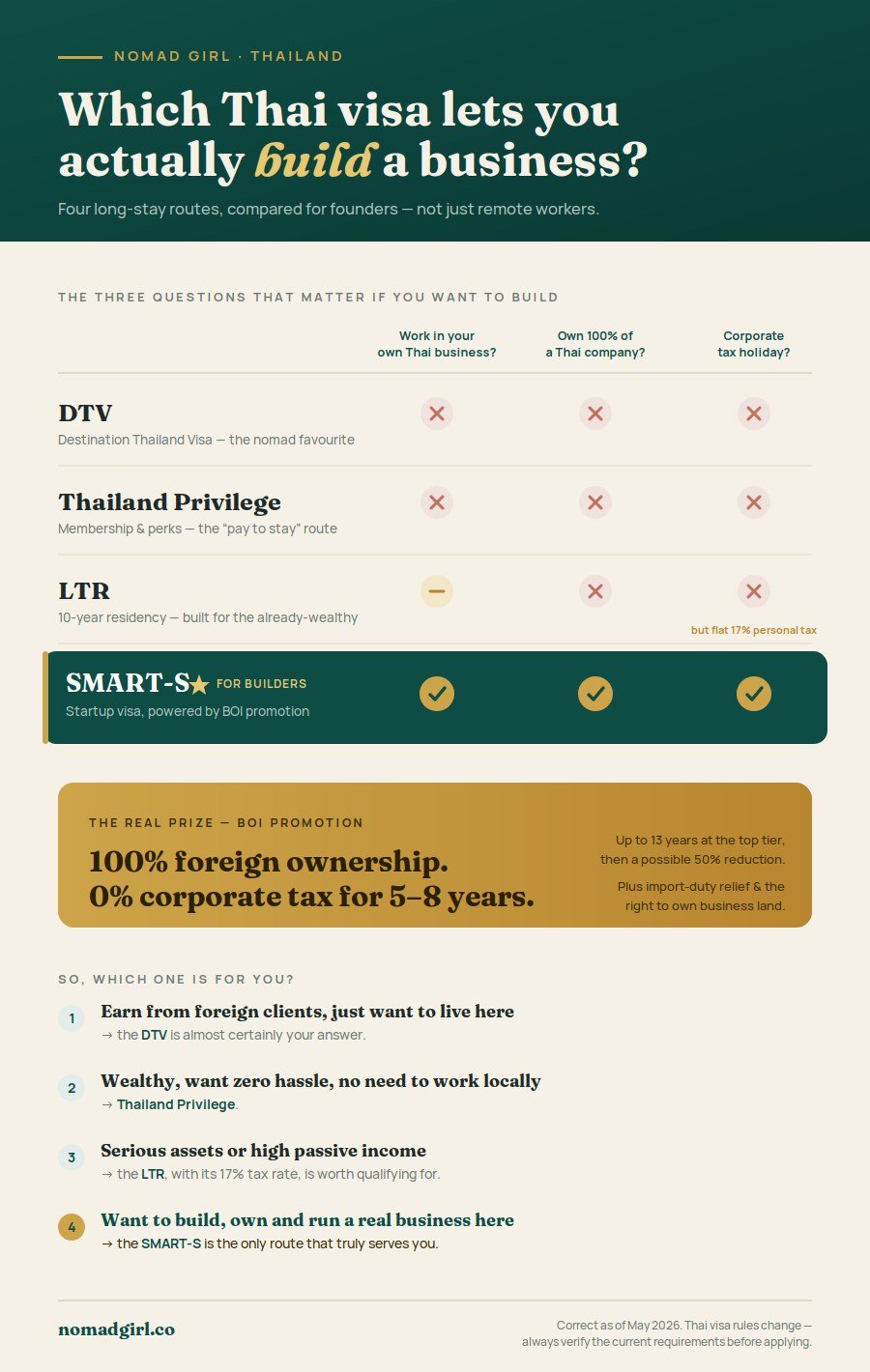
The Destination Thailand Visa (DTV) is the darling of the nomad world right now, and for good reason. It’s a five-year, multi-entry visa, you can stay up to 180 days per entry (extendable by another 180), the proof-of-funds bar is a manageable 500,000 baht, and it costs around 10,000 baht. For a freelancer or remote employee with income coming from abroad, it’s genuinely brilliant.
But here’s the catch that doesn’t get said loudly enough: the DTV is technically a tourist visa sub-category. You are a long-term visitor. It does not give you the right to work for a Thai company or to properly own and run a business inside Thailand. All your income has to come from foreign sources. The moment my plan involved building something in Thailand, serving the Thai market, the DTV stopped making sense. It’s a wonderful visa for working on a business based elsewhere — not for founding one here.
Thailand Privilege: lovely, but it’s a membership, not a business platform
Thailand Privilege (the rebranded Elite Visa) is the “pay to stay” route. You pass a background check, pay the membership fee — packages run from roughly 900,000 baht up to several million in 2026 — and you get a long-stay visa with concierge perks, airport fast-track, the works. No income proof, no asset test, no health insurance mandate. Approval is almost guaranteed if you can pay.
It’s smooth and it’s hassle-free. But it’s still, fundamentally, a premium tourist arrangement. No work rights. No business-ownership advantage. No tax incentives. If you’re wealthy and simply want to live in Thailand without paperwork, it’s a fine choice. For a founder trying to build a company, it doesn’t move the needle.
The LTR: powerful, but built for the already-wealthy
The 10-year Long-Term Resident visa is the one everyone points to when they talk about Thailand “getting serious” about attracting talent — and it’s overseen by the Board of Investment (BOI), which matters, as you’ll see in a moment. It even offers a flat 17% personal income tax rate for highly-skilled professionals in targeted industries, which is the headline tax perk in the whole system.
The problem is the entry bar. The Wealthy Global Citizen category wants USD 1 million in assets including USD 500,000 placed in Thai bonds or property. The Wealthy Pensioner route wants USD 80,000 a year in passive income. The Work-from-Thailand Professional route requires you to be a remote employee of a large established foreign company. None of those describe a founder in the early, scrappy, building phase of a new venture. The LTR is a destination, not a starting point.
The SMART-S: the only one of the four built for people who actually build
This is where I’ve ended up, and once you see the distinction it’s hard to unsee. The SMART-S (“S” for Startup) visa is the only mainstream route that’s designed for foreign entrepreneurs who want to establish, own and operate a real business in Thailand. Here’s what it actually gives you:
- A two-year, renewable visa, with no separate work permit required to work in your own endorsed business.
- Family included: your spouse and children get SMART-O visas for the same duration, and the spouse can work in Thailand without their own work permit.
- Annual immigration reporting instead of the dreaded 90-day check-in.
- No re-entry permit needed, plus fast-track lanes at the major airports.
- A meaningfully lower wealth bar than the LTR: a 600,000 baht deposit held for three months, health insurance, and either 25% ownership of, or a director role in, a certified Thai startup.
But the visa itself is honestly only half the story. The reason it’s the right route for a business builder is what sits underneath it.
The real prize: BOI promotion, 100% foreign ownership and tax holidays
Here’s the part that took me a while to fully understand, and it’s the single biggest reason I’m going this way.
Normally, a foreigner can own no more than 49% of a Thai company. That 49% ceiling is the wall most foreign founders hit. The way through it is BOI promotion — getting your business endorsed by Thailand’s Board of Investment under one of its targeted activity categories.
When the BOI promotes your project, two extraordinary things happen:
- You can own 100% of your Thai company. No Thai majority partner, no nominee arrangements (which Thailand is actively cracking down on in 2026 anyway). The business is genuinely yours.
- You get a corporate tax holiday. Promoted businesses typically receive a corporate income tax exemption — 0% — for five to eight years, and the very top tiers can reach as far as thirteen years. After the exemption period, some categories qualify for a further 50% reduction in corporate income tax for several more years. On top of that come import-duty exemptions, the right to own land for the promoted business, and the ability to remit money abroad in foreign currency.
The SMART-S visa and BOI promotion are designed to work hand in hand: the BOI endorses your startup, the certification opens the SMART-S door, and your company gets the ownership and tax advantages. None of the other three visas — DTV, Privilege or LTR — offer you a path to 100% foreign business ownership combined with a corporate tax holiday. That combination is unique to the BOI route.
The honest part: it’s not a smooth ride (yet)
I won’t pretend this is the easy option. It plainly isn’t. The DTV you can sort yourself in an afternoon. The SMART-S and BOI route is a process — a real one — and I’m living through the friction right now.
My first port of call was a well-known startup program run out of one of Bangkok’s big tech hubs, which bundles SMART-S facilitation with company registration and workspace. On paper it’s a tidy package. In practice, my application has so far gone unanswered — no meaningful response at all. I suspect the arrival of the DTV has quietly drained demand from these startup-visa programs, and some of them simply aren’t chasing applicants the way they once did. The webpage is still up; the enthusiasm behind it seems to have moved on.
So I’m doing what any founder does when one door stays shut: I’m finding others. I’m now lining up a BOI-experienced law firm to handle the application directly, and exploring a couple of parallel avenues so I’m not dependent on a single gatekeeper. It’s more work and more cost than letting an incubator shepherd you through, but it puts the process in my own hands — and frankly, an unresponsive sales inbox isn’t a reassuring preview of how an agent would handle your actual filing.
Who should actually consider this route
Be honest with yourself about which camp you’re in, because it determines everything:
- You earn from foreign clients and just want to live in Thailand → the DTV is almost certainly your answer.
- You’re wealthy, want zero hassle, and don’t need to work locally → Thailand Privilege.
- You already have serious assets or a high passive income → the LTR, with its lovely 17% tax rate, is worth qualifying for.
- You want to build, own and run a genuine business in Thailand → the SMART-S, backed by BOI promotion, is the only route that actually serves you. It’s harder. It’s slower. But it’s the one that ends with a company that’s 100% yours and tax-advantaged for years.
I’ll keep documenting this journey as it unfolds — the law firm hunt, the BOI application, the interview (which, frustratingly, has to be done in person in Bangkok), and whether the 100% ownership and tax holiday live up to the promise. If you’re weighing the same decision, I hope this saves you some of the confusion I waded through.
To be continued…..